949-392-1999

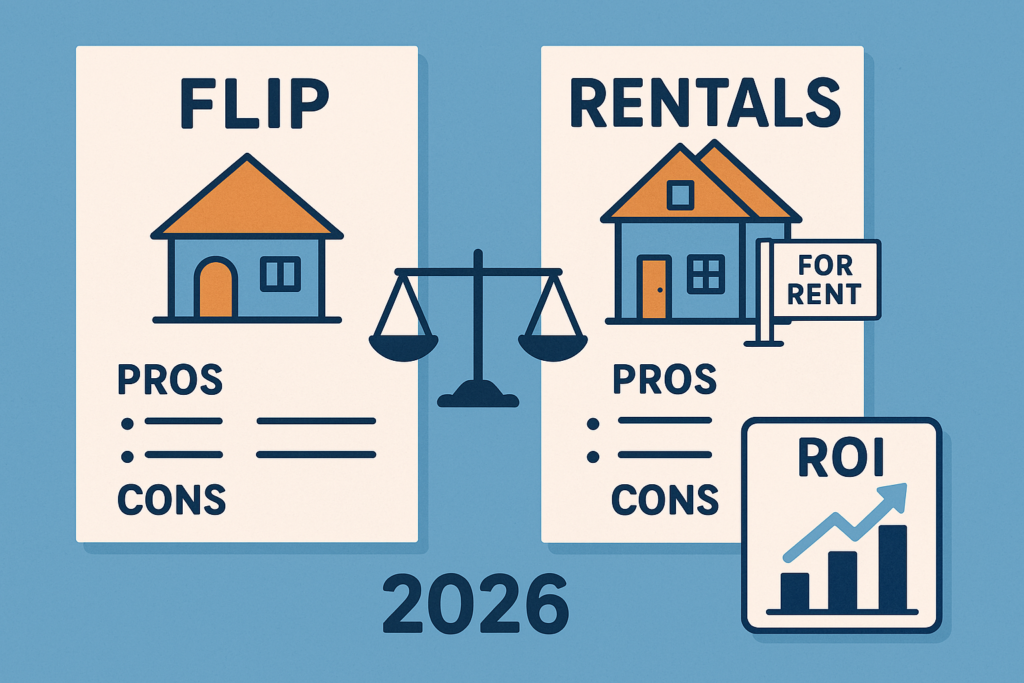
As the 2026 real estate landscape takes shape, investors are asking one of the oldest questions in the business: Should I flip houses or buy rentals this year?
The truth is that both strategies can work—but market conditions, interest rates, and your investment goals make one approach far more advantageous than the other depending on your situation.
Below is a breakdown of both strategies, what’s changing in 2026, and how to evaluate the ROI side-by-side.
The 2026 Market Landscape: What’s New?
Several trends are shaping investment strategy decisions:
-
Interest rates are stabilizing after several years of volatility, creating more predictable financing for both flippers and landlords.
-
Inventory is still tight, especially in entry-level housing, keeping pressure on home prices.
-
Renovation costs are easing, with supply chains normalizing after years of disruption.
-
Rent growth is moderating, but long-term demand for rentals remains strong due to affordability challenges for buyers.
This mix creates opportunity, but success depends heavily on choosing the right strategy for your capital, skills, and timeline.
House Flipping in 2026
Pros of Flipping
- Fast Capital Turnover – Flips allow you to realize profits in months rather than years, making it attractive if you need quick liquidity or want to recycle cash aggressively.
- Less Exposure to Long-Term Financing Costs – Because projects are short-term, you aren’t as affected by interest-rate drift or long amortization schedules.
- Market Appreciation Bonus – If prices continue to climb modestly in 2026, you may gain not only from forced appreciation (renovations) but also from natural appreciation during the project timeline.
Cons of Flipping
- Tighter Margins in High-Price Markets – Even with cooling material costs, acquisition prices remain elevated in many regions, squeezing spread deals.
- Higher Tax Burden – Flipping profits are typically taxed as ordinary income, not long-term capital gains—a major hit to your net ROI.
- Operational Risk Is Higher – Contractor delays, permit issues, and hidden repair problems can derail timelines and budgets, especially if you’re not full-time.
Expected Flip ROI in 2026
While ROI varies widely by market:
-
Typical gross profit margin: 10%–25%
-
Net profit after costs and taxes: 6%–15%
-
Time to complete: 4–9 months
Flips can outperform rentals only if you are skilled at sourcing discounted deals or have strong rehab and project-management experience.
Buying Rentals in 2026
Pros of Rentals
- Cash Flow + Long-Term Appreciation – Even modest cash flow combined with long-term equity growth continues to make rentals a powerful wealth-building vehicle.
- Tax Advantages – Depreciation, interest deductions, and 1031 exchanges often make rentals far more tax-efficient than flipping.
- Hedge Against Inflation – Rents tend to rise with inflation, even when property values fluctuate. This protects your purchasing power over time.
- Passive or Semi-Passive Income – With good property management, rentals can generate income without constant oversight.
Cons of Rentals
- Higher Interest Costs – Even with rate stabilization, financing remains more expensive than it was in the 2020–2022 era, tightening cash flow.
- Slower Liquidity – Your capital is tied up longer, which can limit how fast you scale without partner capital or creative financing.
- Landlord Responsibilities – Even with property management, there’s maintenance, turnover, leasing, and compliance to consider.
Expected Rental ROI in 2026
-
Cash-on-cash returns: 5%–9% (higher in value-add or small multifamily)
-
Total ROI with appreciation + principal paydown: 12%–20% annually
-
Hold period: 5–10+ years for optimal performance
Rental ROI lags behind flipping in the first 12 months but almost always outperforms flips over multi-year horizons.
Flip vs. Rental: Which Produces Better ROI in 2026?
The answer depends on your priorities:
Choose Flipping if you want:
-
Fast returns
-
Short-term projects
-
To build capital quickly
-
To use your renovation or design skills
-
To exit deals quickly to avoid long interest-rate exposure
But expect: higher taxes, more operational risk, and tighter margins in competitive markets.
Choose Rentals if you want:
-
Long-term wealth building
-
Passive income
-
Tax advantages
-
Appreciation + leverage multipliers
-
More predictable returns over time
But expect: slower capital recycling and the need for stable financing.
Hybrid Strategy: Why Many Investors Do Both in 2026
Many investors are combining the strategies:
-
Flip a few houses per year to generate extra capital
-
Deploy that capital into cash-flowing rentals
-
Use BRRRR or creative financing to amplify the rental portfolio
This hybrid approach uses flips as a capital engine and rentals as a wealth engine—a powerful combination in 2026’s market conditions.
Final Verdict: What’s the Best Move in 2026?
- If you need faster capital growth or want to maximize short-term income, flipping may edge out rentals—provided you have sourcing, contracting, and project-management expertise.
- If your priority is long-term wealth, tax reduction, and compounding returns, rentals remain the superior strategy—especially multifamily or value-add properties.
- Most investors find that 2026 rewards those who take a blended approach, using the strengths of each strategy to build both capital and long-term wealth.
META Description:
Discover whether flipping houses or buying rental properties is the smarter investment strategy for 2026. Explore the pros, cons, ROI comparisons, and the market conditions shaping each approach so you can choose the best path for your real estate goals.
