949-392-1999

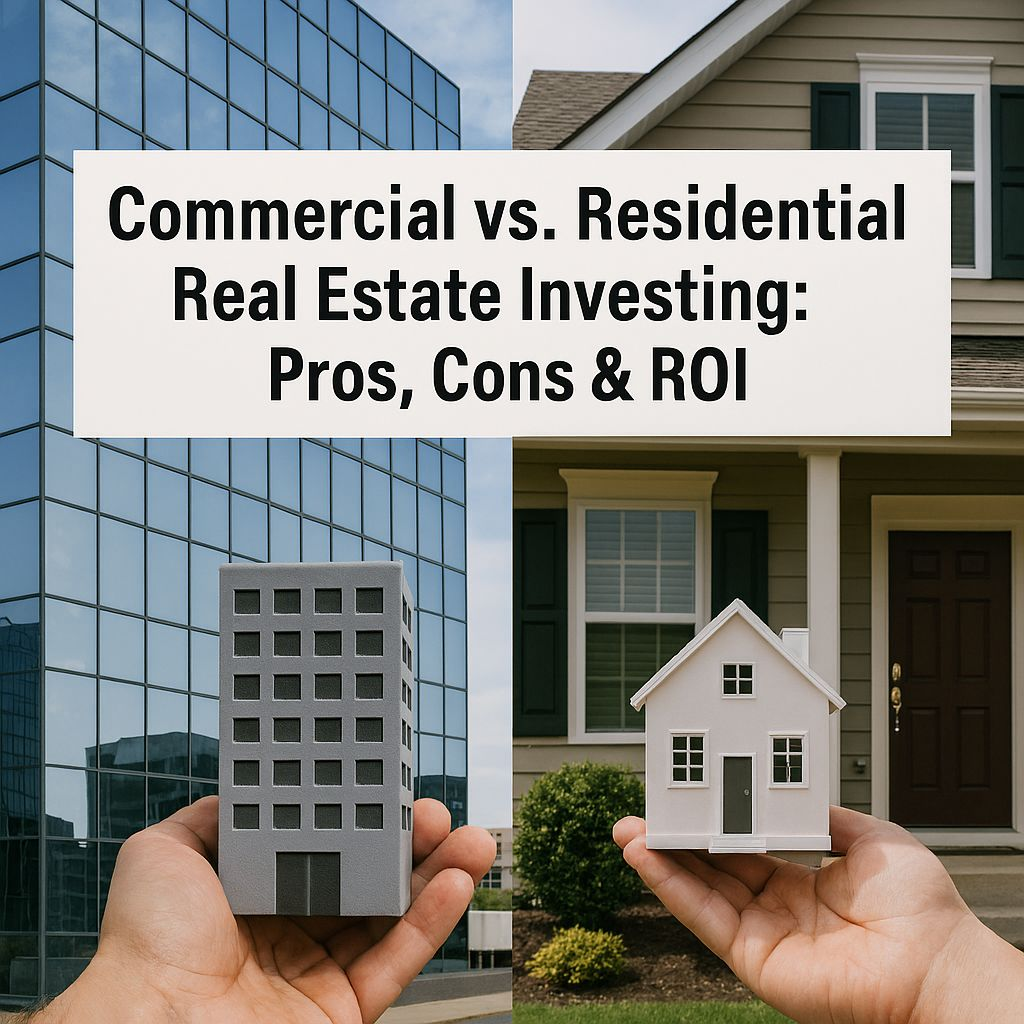
Real estate investing has long been one of the most effective ways to build wealth, generate passive income, and create financial security. Yet one of the biggest decisions investors face is whether to invest in commercial or residential real estate. While both offer opportunities for appreciation and cash flow, they differ significantly in terms of risk, management, financing, and return potential.
Understanding the advantages and disadvantages of each investment type can help investors align their strategy with their goals, experience level, and financial resources.
What Is Residential Real Estate Investing?
Residential real estate refers to properties designed for people to live in. These typically include:
- Single-family homes
- Duplexes and triplexes
- Small apartment buildings
- Condominiums
- Townhomes
- Vacation rentals
Most beginner investors start with residential properties because they are easier to understand and usually require less capital upfront.
Pros of Residential Real Estate Investing
Easier Entry Point
Residential properties generally cost less than commercial properties, making them more accessible for first-time investors. Financing is often simpler as well, especially for owner-occupied properties.
Strong Demand
People always need housing. Even during economic downturns, residential demand tends to remain relatively stable, especially in desirable markets.
Easier Financing
Banks are typically more willing to lend on residential properties because they are considered lower risk. Investors often benefit from lower down payments and favorable mortgage terms.
Simpler Management
Managing a single-family rental is often easier than operating a shopping center or office complex. Many investors self-manage residential properties in the beginning.
Faster Resale Market
Residential properties generally have a larger buyer pool, making them easier to sell compared to specialized commercial buildings.
Cons of Residential Real Estate Investing
Lower Income Potential
While residential properties can provide solid cash flow, the income ceiling is often lower compared to commercial assets.
Tenant Turnover
Residential tenants tend to move more frequently, increasing vacancy costs and maintenance expenses.
Emotional Buyers Affect Pricing
Residential values are often influenced by emotional buying decisions rather than strict financial performance, which can create pricing volatility.
Limited Scalability
Owning ten single-family homes may require significantly more work than owning one commercial building with the same income potential.
What Is Commercial Real Estate Investing?
Commercial real estate includes properties used for business purposes, such as:
- Office buildings
- Retail centers
- Industrial warehouses
- Self-storage facilities
- Large apartment complexes
- Medical buildings
- Hotels
Commercial properties are generally valued based on their income performance rather than emotional market demand.
Pros of Commercial Real Estate Investing
Higher Income Potential
Commercial properties often generate substantially higher rental income and stronger cash flow than residential properties.
Longer Lease Terms
Commercial tenants frequently sign leases lasting 3 to 10 years or more, creating more predictable income streams.
Professional Tenant Relationships
Commercial tenants are typically business owners who treat properties more professionally than many residential tenants.
Value-Add Opportunities
Commercial investors can dramatically increase property value by improving operations, raising rents, or reducing expenses.
Better Scalability
A single commercial property may produce the same income as dozens of residential homes, making portfolio growth more efficient.
Cons of Commercial Real Estate Investing
Higher Capital Requirements
Commercial deals usually require larger down payments, higher reserves, and more sophisticated financing structures.
Greater Economic Sensitivity
Commercial properties can be heavily affected by economic cycles. Office buildings, retail spaces, and hotels may struggle during recessions.
More Complex Management
Commercial properties often involve complicated leases, property maintenance systems, legal agreements, and tenant negotiations.
Longer Vacancy Risks
When a commercial tenant leaves, vacancies may last months or even years depending on the market and property type.
Financing Challenges
Commercial loans typically have shorter terms, balloon payments, and stricter underwriting standards than residential loans.
Comparing ROI: Commercial vs. Residential
One of the biggest factors investors consider is return on investment (ROI). While both asset classes can build wealth, they often do so differently.

Commercial ROI Characteristics
Commercial investors often pursue:
- Higher cash flow
- Larger equity gains
- Forced appreciation strategies
- Portfolio scalability
Commercial properties can deliver stronger returns, but they usually come with higher risk and greater operational complexity.
Which Investment Is Safer?
For most beginners, residential real estate is generally safer and easier to manage. Residential properties tend to perform better during economic uncertainty because housing remains an essential need.
Commercial real estate can produce impressive returns, but it often requires:
- Larger financial reserves
- Better market analysis
- Stronger negotiation skills
- More experience managing risk
That said, certain commercial sectors like industrial warehouses and self-storage facilities have shown remarkable resilience in recent years.
Which Strategy Builds Wealth Faster?
Commercial real estate often accelerates wealth-building faster because investors can force appreciation through improved property performance. Since commercial property values are based heavily on net operating income (NOI), increasing rents or reducing expenses can rapidly increase property value.
For example:
Property Value=NOICap Rate\text{Property Value} = \frac{\text{NOI}}{\text{Cap Rate}}
A modest increase in NOI can dramatically boost a commercial property’s value.
Residential investing, however, may offer a smoother and more stable long-term path, especially for part-time investors or those seeking lower stress.
Who Should Choose Residential Real Estate?
Residential investing may be ideal for:
- Beginner investors
- Part-time investors
- Investors with limited capital
- People seeking simpler management
- Those prioritizing stability over aggressive growth
House hacking, short-term rentals, and small multifamily properties are common starting points for residential investors.
Who Should Choose Commercial Real Estate?
Commercial investing may be best suited for:
- Experienced investors
- Investors seeking larger cash flow
- Entrepreneurs comfortable with risk
- Those with access to substantial capital
- Investors focused on scaling quickly
Commercial investing can become highly profitable for investors who understand market cycles, financing structures, and operational management.
Final Thoughts
Both commercial and residential real estate investing can create substantial wealth when approached strategically. Residential real estate typically offers lower barriers to entry, simpler management, and more stable demand, making it attractive for beginners. Commercial real estate, on the other hand, provides larger income potential, scalability, and opportunities for forced appreciation.
The best choice ultimately depends on an investor’s goals, risk tolerance, available capital, and experience level. Many successful investors eventually own both residential and commercial assets as they diversify and expand their portfolios.
In the end, the most important factor is not necessarily which asset class you choose — but whether you consistently invest, manage risk wisely, and stay committed for the long term.
META Statement
Discover the key differences between commercial and residential real estate investing, including the pros, cons, risks, cash flow potential, and ROI opportunities of each strategy to help investors choose the best path for building wealth.
